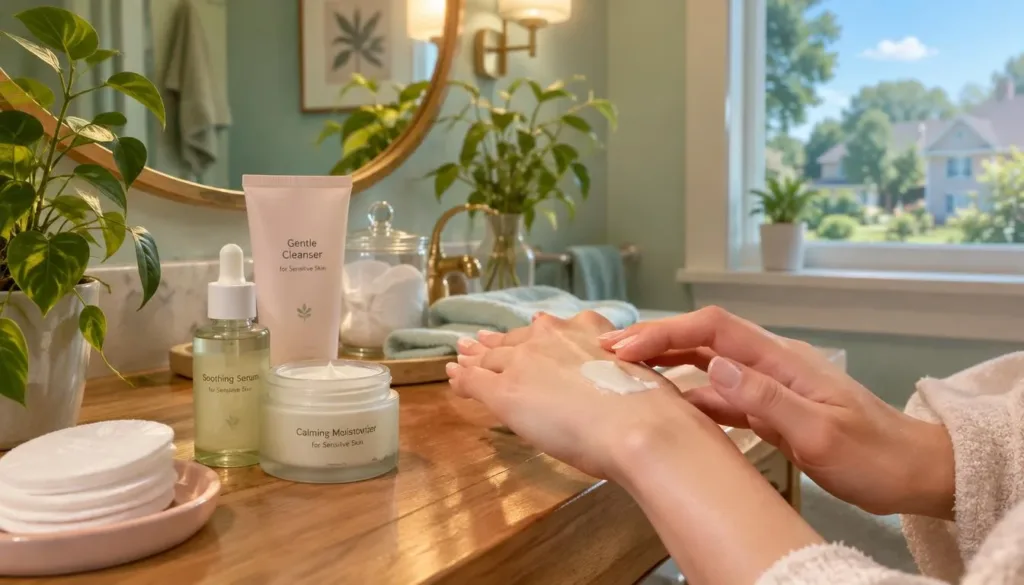
A skincare routine for sensitive skin can be as simple as gentle cleansing, fragrance-free moisturizing, and daily sunscreen. The skin barrier is the outermost layer of skin that helps keep moisture in and irritants out. Could fewer products help calm redness and reduce irritation? A short routine can make sensitivity easier to manage without adding more steps than you need.
You can start with a few basic products, even if your skin reacts to changes in weather or skincare. These seven tips focus on noticing patterns, choosing gentle care, and making changes at a pace your skin can handle. A useful routine does not need many steps. Start with the fewest steps that meet your needs, then make changes slowly.
Key Takeaways
- Keep cleansing gentle and avoid scrubbing.
- Choose a moisturizer without added fragrance.
- Use broad-spectrum sunscreen during the day.
- Add new products one at a time.
- Get help for severe or lasting reactions.
Tip 1: Notice Your Skin’s Patterns and Know When to Get Help
If your face often feels tight, stings, or turns red after products or weather changes, start by noticing when the reaction happens. Sensitive skin may feel tingly, hot, tight, or burning, and triggers can vary from person to person.
Sensitivity can occur with dry, oily, or combination skin, so skin type alone does not explain every reaction. Eczema, rosacea, and contact dermatitis can also cause signs that resemble sensitivity. Repeated, severe, or lasting reactions, hives, or blister-like bumps need a dermatologist’s attention.
Repeated, severe, or lasting reactions, hives, or blister-like bumps need a dermatologist’s attention.
For what to put on sensitive skin on your face, start with a gentle cleanser, a fragrance-free moisturizer, and sunscreen. A small U.S. survey found that 56% of people reporting product reactions reacted to cosmetic products; the survey included only 58 people. The pilot survey on sensitive skin also found that many respondents reacted to products marketed for sensitive skin.
Keep a short note of the product or exposure and the symptoms you notice so you can discuss the pattern with a dermatologist.
Tip 2: Cleanse Gently and Only as Often as Needed
A cleanser should leave your face comfortable, not tight or stinging. A mild, non-abrasive cleanser and lukewarm water are sensible starting points for sensitive skin. For dry or sensitive skin, washing once each evening may be enough.
Use lukewarm water and avoid scrubbing
Hot water and rough rubbing can add irritation without making skin cleaner. The skin barrier can become uncomfortable when cleansing strips away too much moisture. Keep the process light, especially when your face already feels dry or reactive.
- Use your fingertips instead of a rough cloth or brush.
- Rinse gently, then pat your face dry with a clean towel.
- Remove makeup or sunscreen at night without repeated scrubbing.
These habits can make a skincare routine easier to stick with. They also limit friction, which can be a problem for skin prone to redness or irritation. You do not need a brush or gritty cleanser to clean away daily buildup.
Adjust cleansing to dryness and daily buildup
Dry skin may feel best with one evening cleanse, while oily skin can need a different approach. Notice whether your face feels uncomfortable after washing or carries substantial daily buildup. Adjust how often you cleanse based on those signs, rather than following a schedule that leaves your skin worse.
Makeup and sunscreen still need to come off at night, but repeated passes can irritate skin. Choose a cleanser that removes them without a long scrubbing session. If your face feels uncomfortable, reduce friction first and see whether that helps.
Harsh cleansing and scrubbing can irritate skin, while regular moisturizing can ease dryness and itchiness. If washing leaves your face persistently tight or itchy, reduce friction and reassess how often you cleanse.
Tip 3: Moisturize to Support Your Skin Barrier
A simple fragrance-free moisturizer is a practical place to start if your skin feels dry or easily irritated. Added scents can trigger irritation or allergic reactions for some people. Fragrance-free is a useful label to check, not a promise that a product will suit everyone.
Choose a fragrance-free moisturizer
Read the product label if fragrance tends to bother your skin. A fragrance-free formula avoids added scent, while “unscented” does not always mean a product has no scent-masking ingredients. Your own response still matters, even when a label sounds reassuring.
There is no need to build an expensive shelf to support your skin barrier. An affordable skin-care routine for sensitive skin can focus on a cleanser, moisturizer, and sunscreen. A long list of add-ons can make it harder to tell which products your skin tolerates.
Look for hydration and barrier-supporting ingredients
Moisturizers can include ingredients that help hold water in the skin or support a smoother feel. Three examples have different roles:
- Ceramides help keep skin hydrated.
- Hyaluronic acid supports hydration and can improve skin texture.
- Glycerin is a humectant that draws water into the skin.
These ingredients can support hydration, but no single ingredient guarantees comfort. A formula’s other ingredients and your own sensitivity can affect how it feels. If a product has several unfamiliar ingredients, keep the label and note how your skin responds.
Moisturizer can help limit moisture loss after washing and ease dry skin. Some formulas feel richer, while lighter ones may suit people who dislike a heavy feel. Choose a texture you can use comfortably, rather than one based only on skin-care trends.
If a moisturizer stings or makes irritation worse, stop using it and return to products you already tolerate.
How to Build a Skincare Routine for Sensitive Skin With Daily Sun Protection
Make broad-spectrum sunscreen a daily step, even when the rest of your routine is short. Broad-spectrum protection covers UVA and UVB rays. The FDA recommends SPF 15 or higher for regular sun protection; the American Academy of Dermatology recommends SPF 30 or higher for tweens and teens.
Choose a broad-spectrum, water-resistant sunscreen that your sensitive skin can tolerate. Apply it 15 minutes before sun exposure, then reapply at least every two hours. Reapply more often when swimming or sweating. Water-resistant labels list a 40- or 80-minute duration; no sunscreen is waterproof.
| Label or feature | What it means | Practical detail |
|---|---|---|
| Broad spectrum | UVA and UVB protection | Choose it for regular protection |
| SPF 15 or higher | FDA baseline | Use as part of sun protection |
| Water resistant, 40 minutes | Labeled water-resistance duration | Reapply after that swimming or sweating interval |
| Water resistant, 80 minutes | Labeled water-resistance duration | Reapply after that swimming or sweating interval |
In 2026, the FDA added bemotrizinol as a permitted over-the-counter active ingredient. It protects against UVA and UVB rays and is considered generally recognized as safe and effective for adults and children six months and older. The FDA’s sunscreen guidance says infants younger than six months should stay out of the sun; ask a doctor before applying sunscreen to them.
Follow the water-resistance time printed on the label when you swim or sweat.

Tip 5: Add New Products One at a Time
If you change cleanser, moisturizer, and serum together, it becomes difficult to tell which one your skin dislikes. One at a time makes it easier to spot a possible trigger. Test a small amount on a limited area before using a product across your face.
Follow these steps when you want to try a new product:
- Choose one product to try.
- Test a small amount on a limited area of skin.
- Wait to see how your skin responds before using it on your whole face or adding another new product.
This small-area test can help you notice a reaction before full-face use. It does not guarantee that the product will suit your whole face or that you will never react later. Avoid changing several parts of your routine at once.
A product labeled “for sensitive skin” can still cause irritation for you. In a small survey, 72% of respondents who reported cosmetic reactions also reported reactions to products marketed for sensitive skin. That survey had only 58 participants, so it does not predict how every person will respond.
Keep track of which product you introduced and what you noticed. If you change several products at the same time, you lose a useful clue about your skin’s reactivity. Add another new product only after you have a clear sense of how the first one affects your skin.
Tip 6: Use Active Treatments Carefully, Especially for Acne
If you have acne-prone, easily irritated skin, an active treatment can help, but more product is not a shortcut. Acne often starts when pores clog, while hormones can increase oil production. More is not faster when a treatment can irritate your skin.
Know what common acne treatments target
The 2024 American Academy of Dermatology guideline strongly recommends topical retinoids and benzoyl peroxide. It conditionally recommends topical salicylic acid and azelaic acid. These ingredients target acne in different ways, so a dermatologist can help choose a plan for your skin.
Topical retinoids help clear clogged pores and treat blackheads, whiteheads, and some pimples. Adapalene is a nonprescription retinoid. Benzoyl peroxide targets acne-causing bacteria. The acne treatment guidance also recommends broad-spectrum, water-resistant SPF 30 or higher for people using a topical retinoid, along with shade and sun-protective clothing.
Reduce irritation without overusing treatment
Topical acne treatments can cause dryness, irritation, peeling, or burning. Using more than directed will not clear acne faster. Follow the product directions, and ask a dermatologist before changing how you use a retinoid.
If a retinoid irritates your skin, a dermatologist may suggest a smaller amount, less frequent use, or applying moisturizer first. Make those changes with their help, not by guessing at a new schedule. A steady plan should still feel manageable.
Some acne plans combine topical treatments that work in different ways. The guideline describes this as a good practice, but more products can also raise the chance of irritation. A dermatologist can help balance treatment goals with your skin’s comfort.
Give treatment time and check possible triggers
Acne treatment often takes at least 6 to 8 weeks before fewer breakouts appear. Clogged pores and hormone-related oil production are central acne contributors, though triggers differ. During puberty, androgens can enlarge oil glands and increase oil production.
Stress may worsen existing acne, and too little sleep can play a part. Oily makeup, skin-care products, and hair products such as pomade may also worsen breakouts. Some foods may affect acne for some people, but food is not the only cause.
Evidence on low-glycemic eating is mixed, and more research is needed. Studies have linked cow’s milk to acne, but findings remain incomplete; yogurt and cheese have not been found to increase breakouts. Avoid making major diet changes based on acne alone.
Ask a dermatologist before changing a retinoid schedule because of irritation.
Tip 7: Keep the Routine Simple for Your Skin Type
A basic routine can work across skin types, with small adjustments for how dry or oily your face feels. Oily or combination skin can still be sensitive and does not automatically need extra steps. A cleanser, moisturizer, and daytime sunscreen can cover the basics.
The American Academy of Dermatology recommends these product types for tweens and teens: a non-abrasive cleanser, fragrance-free moisturizer, and broad-spectrum, water-resistant sunscreen with SPF 30 or higher. A Korean skincare routine trend does not mean sensitive skin needs many layers. A serum or eye cream is optional, not a default need.
| Time or situation | Cleanse | Moisturize | Protection or optional step |
|---|---|---|---|
| Morning | Rinse or use a gentle cleanser as needed | Fragrance-free moisturizer | Broad-spectrum sunscreen |
| Evening | Gentle cleanser to remove the day’s buildup | Fragrance-free moisturizer | No sunscreen step |
| Makeup or sunscreen day | Remove gently with a cleanser you tolerate | Moisturize if needed | Keep any treatment optional |
This table is a starting point, not a rule for every face. Dry skin may need moisturizer after cleansing, while oily skin may prefer a lighter feel. A simple at-home routine can change with the season or with how your skin feels that day.
A 2026 survey of 168 dermatologists and dermatology residents in the Netherlands found that 91.6% had concerns about the popularity of multi-step routines. Only 12.5% actively recommended them.
Keep a step only when it meets a real need and your skin tolerates it.
Conclusion
A comfortable routine is usually built through a few gentle choices, not a crowded shelf. Gentle cleansing, a moisturizer your skin tolerates, and daily sun protection are enough to begin. Simple can be useful, especially when you are still learning what affects your skin barrier.
You do not need to solve every concern at once. Keep notes when reactions return, and bring them to a dermatologist if symptoms are severe or persistent. That can make it easier to discuss your routine and decide which changes matter.
Start with one basic change, and contact a dermatologist if reactions keep returning or interfere with daily life.