
A useful skincare routine for acne is a short sequence of gentle cleansing, one targeted acne treatment, moisturizer, and daytime sunscreen. What if fewer products could make your routine easier to follow? Sebum is the oily substance produced by sebaceous glands. Your skin may need time to adjust, so comfort matters as much as choosing products. A few steady steps can help you care for acne-prone skin without turning each morning into a project. You can change the routine based on how your skin responds. Start with the basics rather than adding several new products at once.
Key Takeaways
- Keep the routine simple and consistent.
- Choose one acne treatment to start.
- Use gentle products that feel comfortable.
- Give a routine time to work.
- Seek care when acne is severe or leaves scars.
What Causes Acne and Which Lesions Can It Create?
A blackhead and a tender, deep nodule are different acne lesions, but both begin when a follicle becomes clogged. Acne can involve excess sebum, blocked pores, bacteria, and inflammation. Acne is not a sign that your skin is dirty. Washing harder cannot remove the underlying process and may irritate skin.
Sebum and dead skin cells can build up inside a follicle, the small opening around a hair. Microbial activity involving Cutibacterium acnes can add to inflammation. A clinical overview in StatPearls’ acne reference describes these common factors and lesion types. Blackheads and whiteheads are clogged, non-inflammatory lesions; papules, pustules, nodules, and cysts are inflamed lesions.
| Lesion | What it looks like | Inflammatory? |
|---|---|---|
| Blackhead | Visible dark plug | No |
| Whitehead | Closed pale bump | No |
| Papule | Inflamed raised bump | Yes |
| Pustule | Inflamed bump with visible pus | Yes |
| Nodule or cyst | Deeper inflamed lesion | Yes |
Some lesions sit near the skin’s surface, while others reach deeper tissue. Their depth and tenderness can affect comfort and the chance of lasting marks. A dark plug is not dirt trapped in a pore; its color comes from material exposed to air.
A deeper or painful lesion deserves more care than a small surface-level blackhead.
Notice whether a spot is shallow or deep, and whether it hurts. The common acne lesion types can help you describe what you see during a clinical visit.
What Goes Into a Skincare Routine for Acne?
A practical daily routine follows the same order in the morning and evening, with sunscreen added last in the morning. Basic product types are enough to begin, and an acne skin care routine at home can stay short. You do not need toner or several serums to take the first useful steps.
Morning basics for acne-prone skin
Use a gentle cleanser to remove sweat and oil without leaving your face tight. If your skin feels comfortable, a water rinse may be enough. You can add one acne treatment if its directions fit your routine.
Apply moisturizer next, then finish with a broad-spectrum sunscreen rated SPF 30 or higher. Choose a water-resistant formula if you swim or sweat. The American Academy of Dermatology’s simple teen routine includes these basic product types, with sunscreen for daily use.
Look for a cleanser and moisturizer that suit your skin’s feel, not a long list of claims. A broad-spectrum sunscreen helps protect against both UVA and UVB rays. Daily use matters more than collecting several sunscreen products.
Evening cleansing and treatment
At night, remove makeup and sunscreen, then wash with a gentle cleanser. Apply one chosen treatment as directed, and follow with moisturizer. Keep the number of products low while you learn how your skin responds.
Double cleansing means using an oil-based cleanser first, followed by a water-based cleanser. It is optional, not a required acne step. An acne-prone skin routine with products can use this method when makeup or water-resistant sunscreen is hard to remove.
Some people need only one evening cleanse, while others prefer the added first step. The goal is to remove residue without making your skin feel scrubbed or raw. Your cleanser should rinse away easily and leave no tight, squeaky feeling.
A skincare routine for acne-prone skin can work at home with these basic steps. You can keep acne products simple rather than adding a toner or several serums. If makeup or water-resistant sunscreen is hard to remove, use an oil-based cleanser before your regular cleanser.
Which Acne Treatment Ingredients Have the Strongest Support?
Topical benzoyl peroxide and retinoids have the strongest guideline support, while salicylic acid and azelaic acid have conditional support. Strong support does not mean every ingredient suits every person. Start with one active ingredient, rather than adding several at once.
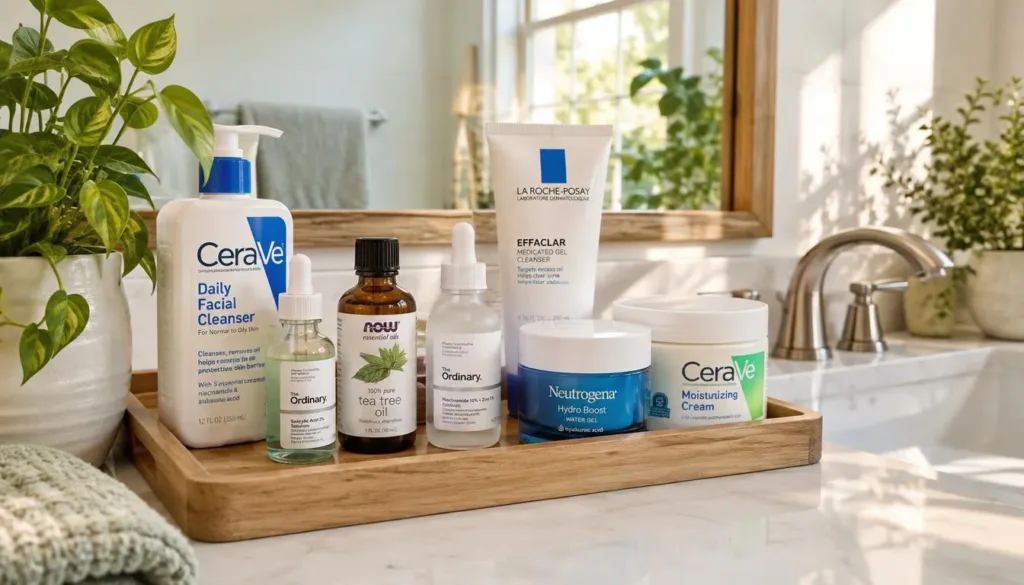
The 2024 American Academy of Dermatology guideline strongly recommends benzoyl peroxide and topical retinoids, alone or in set combinations. It conditionally recommends salicylic acid and azelaic acid. These options work in different ways, so a clinician may combine treatments when needed.
| Ingredient | Guideline support | Common role | Practical caution |
|---|---|---|---|
| Benzoyl peroxide | Strong | Helps target inflammatory acne | May dry skin and bleach fabric |
| Topical retinoids | Strong | Help keep follicles clear | May irritate and increase sun sensitivity |
| Salicylic acid | Conditional | Helps with clogged pores | Can dry or irritate |
| Azelaic acid | Conditional | An additional topical option | Introduce based on tolerance |
The guideline supports combining topical treatments with different actions, but that does not mean starting several actives together. In 2026, the FDA approved an over-the-counter gel with adapalene 0.1% and benzoyl peroxide 2.5% for people aged 12 and older in the United States.
Use that combination once daily as directed. In studies, inflammatory lesions fell by up to 70.3% at week 12, and the combination worked better than either ingredient alone or the gel base. The week-12 study result describes the measured change, not a promise for every person.
Adapalene 0.3% with benzoyl peroxide 2.5% remains prescription-only in 2026. Skin can react differently to each strength, so check the product label before use. Check the active ingredient and strength on the label, since the 0.1% adapalene OTC approval does not apply to the 0.3% strength.
Adjust the Routine for Skin Type and Age
If your face gets shiny quickly or you are managing acne as an adult, the routine can stay simple while the textures change. Comfortable textures can make daily use easier. Oily skin can still need moisturizer.
Oily skin and men’s routines
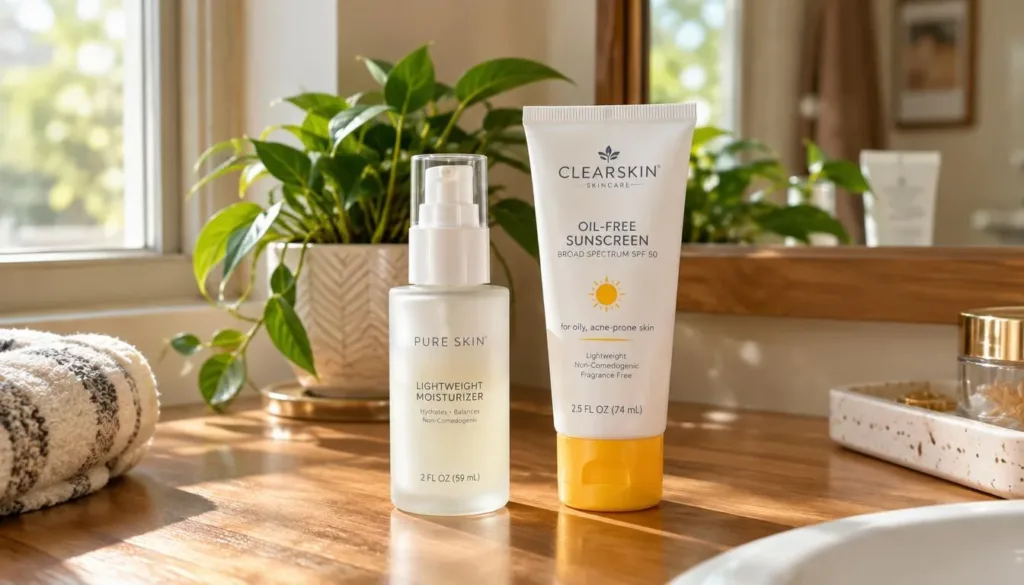
Oil production varies from person to person, and a shiny face does not mean moisturizer is unnecessary. Try a lightweight, non-comedogenic moisturizer, which is less likely to clog pores. Non-comedogenic sunscreen and makeup can also suit acne-prone skin.
Men do not need a separate acne routine. Shaving and facial hair can affect comfort, especially around active breakouts. Use a light touch and avoid scraping or irritating sore areas while shaving.
People with oily skin may prefer a gel or lotion texture over a rich cream. That choice is about how a product feels, not a need to strip away oil. A moisturizer can help your skin tolerate treatment without adding a heavy feel.
Teen and adult routines
Acne is common in adolescence and early adulthood, affecting around 85% of people aged 12 to 24. It can continue later in life: more than 25% of women and 12% of men in their 40s have acne.
The 2024 guideline covers adults, adolescents, and preadolescents aged 9 and older. Teen and adult routines can use the same basic steps, with products chosen for each person’s comfort and needs. A teenager can start simply, with an adult helping read product directions when needed.
Choose non-comedogenic makeup, moisturizer, and sunscreen when those products suit your skin. You may need to try different textures before finding ones you will use. Choose a moisturizer and sunscreen that feel comfortable enough for you to use consistently.
Keep Acne Care Gentle and Manageable
If your face feels tight, stings, or flakes after adding products, simplifying is usually a better next step than adding another active. A gentle routine can be fragrance-free and affordable. You do not need toner or several serums to care for acne.
Try one new product at a time so you can spot what may cause a reaction. Test a small area before applying a new product across your face. This can help you notice a problem early, though it cannot rule out every reaction.
Skin may need 6-8 weeks of steady use before you notice improvement. Dry or sensitive skin may need only one wash in the evening. Washing affected skin no more than twice a day can help limit irritation.
Benzoyl peroxide and salicylic acid may cause dryness or irritation. Benzoyl peroxide can also bleach towels and clothing. Topical retinoids may raise irritation or sun sensitivity, so handle them with care.
- Skip scrubs and harsh cleansing.
- Reduce washing if your skin feels tight.
- Moisturize daily.
- Protect fabric from benzoyl peroxide and use care with sun exposure during retinoid treatment.
A basic routine can cost less when you skip extras that do not serve a clear purpose. Give each change enough time to show how your skin responds, and write down when you start it. If irritation is persistent or severe, stop the new product and ask a health professional for guidance.
When Should You See a Dermatologist?
Make an appointment when acne is scarring, leaving persistent dark marks, or not improving after a few months of OTC care. Professional care can help when breakouts are severe or hard to manage. Acne alone cannot confirm PCOS.
Signs that acne needs professional care
A dermatologist can assess acne that leaves scars or dark marks, or does not improve after a few months of over-the-counter treatment. Deep, severe lesions also deserve medical attention. Acne can affect mood, confidence, and daily life, which are valid reasons to ask for help.
The AAD strongly recommends oral isotretinoin for severe acne, acne that causes emotional burden or scarring, or acne that does not respond to standard oral or topical treatment. It is a clinician-guided option, not a routine first step for every breakout.
Seek help sooner if acne is severe or its emotional burden is affecting your daily life.
Acne and PCOS: what appearance can and cannot tell you
Acne linked with PCOS has no reliable look that confirms the condition. A 2025 review estimated acne in 49% of women with PCOS, with a 95% confidence range of 47%-52%. The estimate had high variation across studies and signs of publication bias.
After adjustment for publication bias, the estimate was 37%, with a 95% confidence range of 35%-39%. Estimates were 66% for adolescents under 18 and 42% for women over 30. Mild acne was the most common severity group, at 40%.
These figures vary widely across studies, with heterogeneity of I² = 98.86% and publication bias at P < 0.001. Acne can relate to higher androgen levels, but it can also have non-androgenic causes. The adjusted prevalence estimate is one reason not to treat acne as a diagnosis.
Adolescent PCOS assessment can be difficult because symptoms may overlap with puberty. Clinicians consider several signs together, including excess hair growth, severe acne, and menstrual changes after periods begin.
- Acne can have non-androgenic causes.
- Adolescent symptoms can overlap with puberty.
- Clinicians consider several symptoms together.
- Polycystic ovaries alone are not enough for adolescent diagnosis.
Dark marks, scars, deep lesions, and the effect on your well-being all matter when deciding to seek care. A clinician can assess the full pattern rather than relying on one skin change.
Conclusion
A manageable routine is one you can follow consistently without leaving your skin uncomfortable. Give your skin time to respond, and keep the plan simple enough to maintain on busy days. An acne treatment should fit your main concern and your ability to use it as directed.
You do not need to judge progress by one new blemish or one good day. Notice changes over several weeks, including comfort and irritation. Pick one treatment that fits your main concern, follow its directions, and note how your skin responds.