
For beginners, start by exfoliating once a week, and do not go beyond two or three sessions a week. The right frequency depends on your skin’s response and the strength of your product. Could exfoliating more often actually make your skin feel worse?
At-home exfoliation is optional, and a simple routine can work well without it. Starting slowly gives you time to see how your skin responds before changing your schedule. More exfoliation is not automatically better. If your skin feels comfortable, there is no need to add another step just to follow a trend.
Key Takeaways
- Start with one session a week if you are new to exfoliation.
- Do not exfoliate every day.
- Use product strength and skin comfort to guide changes.
- Keep the rest of your routine simple while testing a new product.
- You can leave exfoliation out if your skin feels fine without it.
You can skip exfoliation entirely if your skin is comfortable without it.
What Does Exfoliation Do?
Your skin sheds dead cells naturally, and exfoliation gives surface buildup a gentle nudge off the skin. People shed around 500 million skin cells each day, though the cells are too small to notice. That steady renewal is part of how the skin’s surface changes over time.
Exfoliation removes some dead skin cells from the surface. This can help skin feel smoother or look less dull, but results differ from person to person. Exfoliation does not prevent acne or guarantee that other products work better.
Treat exfoliation as an optional step, not a requirement for healthy skin.
Your skin barrier is the outer layer that helps retain moisture and protect skin from irritants. Harsh or frequent exfoliation can put extra stress on this layer. A healthy skin routine does not need to chase a perfectly smooth surface.
Skin texture also changes with age, weather, and daily care. A mild approach may help with surface roughness, but it cannot change every cause of uneven texture. Notice how your skin feels, rather than judging the step by an instant change.
Some people enjoy the feel of exfoliation, while others find it adds little to their routine. Both responses are normal. Treat exfoliation as an optional step, not a requirement for healthy skin.
How Often to Exfoliate Face by Skin Type
A safe starting schedule is once a week, then adjust only if your skin stays comfortable. Skin type, product strength, and method shape a sensible frequency. Start with the lower end when you are unsure.
| Skin type | Starting frequency | Adjustment |
|---|---|---|
| Dry or sensitive skin | Once weekly | Consider twice weekly only if comfortable |
| Oily skin | Once or twice weekly | Up to two or three sessions if tolerated |
| Acne-prone skin | Once weekly | Increase only if the skin stays comfortable |
| Combination skin | Once or twice weekly | Adjust only while skin remains comfortable |
| Normal skin | Once or twice weekly | Increase only if needed and tolerated |
Dry or sensitive skin
Dry or sensitive skin often does best with one mild session per week. Consider twice weekly only if your skin remains comfortable between sessions. A stronger product can call for a longer break, even when the label suggests frequent use.
For sensitive skin, start with less rather than trying to match someone else’s routine. The same product can feel different on two people, even when their skin types seem alike.
Oily or acne-prone skin
Oily skin may tolerate more frequent exfoliation than dry skin, but two or three sessions weekly is an upper range, not a goal. People with acne-prone skin should also start slowly, since irritation can make a routine harder to manage.
How often to exfoliate your face if you have oily skin depends on comfort and product strength. If oiliness persists, do not assume that adding more sessions will solve it.
Combination and normal skin
For combination and normal skin, start once or twice each week. Pay attention to how different areas respond; the cheeks and forehead may not feel the same. Adjust only when your skin stays comfortable over time.
How often to exfoliate your face for men follows the same skin-type guidance. Skin needs do not change based on gender.
How often to use a chemical exfoliant
You can chemically exfoliate your face a couple of times a week with a mild product if your skin tolerates it. Cleveland Clinic recommends using a glycolic acid chemical exfoliant a couple of times a week. A stronger product may need less frequent use.
More aggressive exfoliation should happen less often because skin needs time between sessions. A product’s strength and the way you use it both matter. The schedule does not need to rise just because your skin seems oily.
Do not exfoliate every day, and give your skin time to recover between sessions. If you use several exfoliating products, count them together rather than treating each one as a separate schedule. Keep the total at two or three sessions a week or fewer, even if you use more than one exfoliating product.
Choose Between Physical and Chemical Exfoliation
A washcloth, a scrub, or an acid-based product can exfoliate, but each works differently. Choose a method that fits your skin and how it responds. A face exfoliator is suitable when it addresses your concern without making your skin uncomfortable.
| Method | Examples | Practical fit or caution |
|---|---|---|
| Physical exfoliation | Washcloth, scrub, brush, sponge | Friction removes surface buildup; use a gentle touch |
| AHAs | Glycolic acid, lactic acid | May suit some skin; strength and tolerance matter |
| BHAs | Salicylic acid | Often chosen for oily or acne-prone skin; start gently |
Physical exfoliation with tools or scrubs
Physical exfoliation uses friction from a washcloth, scrub, brush, or sponge to lift dead skin cells. A washcloth gives you more control than a rough scrub, since you can keep pressure light. Tools can feel harsh if you press or rub too hard.
A mild washcloth may suit dry, sensitive, or acne-prone skin. Oily or thicker skin may tolerate stronger mechanical methods, but comfort still matters. A product that leaves skin sore is too harsh for your routine.
Chemical exfoliation and the best face exfoliator for you
Chemical exfoliation uses acids to loosen dead cells at the surface. Glycolic acid and lactic acid are alpha hydroxy acids, or AHAs. Salicylic acid is a beta hydroxy acid, or BHA.
A mild chemical exfoliant may suit dry, sensitive, or acne-prone skin. People with oily or thicker skin may tolerate stronger chemical methods. The best exfoliator for your face is the one your skin can handle, not the one with the strongest label.
There is no single best exfoliator for every face. Match the method to your skin type and tolerance, and consider how the product fits the rest of your routine. Choose the gentlest method that addresses your concern without leaving your skin uncomfortable.
How to Exfoliate Without Irritating Your Skin
A gentle hand matters more than trying to make an exfoliant feel stronger. Follow the product directions and use light pressure. Scrubbing harder does not make exfoliation safer or more effective.

- Apply the product as directed on its label.
- If it calls for rubbing, use gentle pressure and small circles for about 30 seconds.
- For a rinse-off product, rinse well with lukewarm water.
- Stop if your skin feels uncomfortable instead of rubbing harder.
Not every exfoliant is meant to be rinsed away. Scrubs and other rinse-off products should be rinsed as directed, while leave-on products stay on according to their label. Check the product type before you begin, especially when using an acid.
A short, careful application is enough. You do not need to feel a strong tingle or see flakes for exfoliation to count. When skin feels uncomfortable during use, continuing can add irritation without improving the result.
Keep your touch light around areas that feel delicate, such as the sides of the nose. Do not add extra rubbing to reach a spot that still feels rough. Never scrub harder to chase a smoother result.
Using Exfoliants With Retinoids or Benzoyl Peroxide
If benzoyl peroxide is already part of your routine, you do not need to add an exfoliating acid by default. Do not combine benzoyl peroxide and exfoliating acids on the same area in one routine unless a dermatologist designed that plan.
Retinoids and retinol
Retinol and prescription retinoids can make skin more sensitive or cause peeling. Exfoliating at the same time may add dryness and irritation. For some people, using both can worsen acne breakouts rather than help the routine.
Prescription products need extra care because your treatment plan may already affect how your skin responds. A dermatologist can help you decide whether an exfoliant fits with that plan. Do not add one just because your skin has acne.
Benzoyl peroxide and exfoliating acids
Benzoyl peroxide is an acne treatment, not a reason to exfoliate. Avoid applying salicylic, glycolic, or lactic acid to the same area in the same routine as benzoyl peroxide, unless a dermatologist designed that plan.
If you have acne, piling on products can make a routine harder to tolerate. A clinician can help you choose an approach that suits your skin and treatment goals. These are options to discuss with a dermatologist:
- Use exfoliating acids on separate nights.
- Lower the frequency of exfoliation.
- Pause exfoliation while the acne plan stabilizes.
The best choice depends on the products you use and how your skin responds. You do not need to stop a prescribed treatment on your own to make room for an exfoliant. If you use a prescription retinoid or have a treatment plan, check with your dermatologist before combining actives.
AHAs and Sun Protection
AHA products can increase sensitivity to ultraviolet light, so sun protection belongs in the plan. Use sunscreen, wear protective clothing, and limit sun exposure while using an AHA and for one week after stopping it.
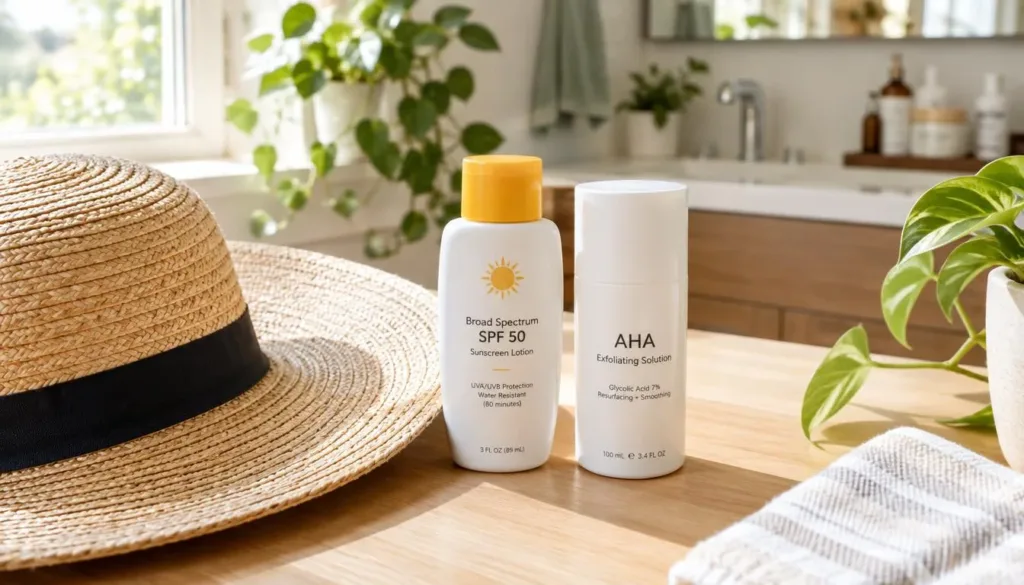
In one study, volunteers used an AHA cream for four weeks. Their sensitivity to UV-related skin reddening rose by 18 percent. Average sensitivity to UV-induced cell damage doubled, though people varied considerably in their response.
The increase in UV sensitivity was reversible. One week after treatment stopped, tested skin sites showed no significant differences. That finding does not replace daily sun protection while an AHA is in use.
The Cosmetic Ingredient Review Expert Panel found consumer glycolic or lactic acid products safe for use under stated conditions. The AHA concentration must be 10 percent or less, and the final product pH must be 3.5 or greater.
The product must also protect against increased sun sensitivity or direct consumers to use daily sun protection. Read the label for its sun guidance, since the conditions apply to the finished product, not just the acid alone.
Concentration alone does not determine how strongly an AHA exfoliates. Acid type, product pH, and other ingredients also shape its effect. A high percentage does not tell the whole story about a product.
Sun protection is part of using an AHA, not an extra step to consider only on bright days. Follow the label’s advice for your product and keep protection in place after you stop using it. Follow the product directions for sun protection while using an AHA.
Where Exfoliation Fits in a Skincare Routine
Keep the routine simple: place exfoliation at the first step you choose for that session, then moisturize. Cleanse or exfoliate first, but do not use both as the first step. Moisturizer follows, and sunscreen finishes a morning routine.
| Routine step | Morning | Evening |
|---|---|---|
| First step | Cleanser or exfoliant | Cleanser or exfoliant |
| Moisturizer | After cleansing or exfoliating | After cleansing or exfoliating |
| Sunscreen | Final step | Not needed as a routine step |
Morning routine
In the morning, choose cleanser or exfoliant as your first step for that session. Apply moisturizer after exfoliating. Sunscreen goes on last, over the rest of your morning skin care.
Cleveland Clinic advises using either a cleanser or an exfoliant first, not both. This keeps the opening steps clear and avoids adding an extra cleansing step before an exfoliant. A simpler routine can also make it easier to spot what your skin tolerates.
Evening routine
At night, start with either a cleanser or an exfoliant. Apply moisturizer after exfoliating to help keep skin hydrated. You can keep the rest of the routine basic if your skin prefers fewer products.
Moisturizer can help reduce moisture loss after the skin has been exfoliated. Apply it soon after the step, rather than leaving skin bare while you wait. If you exfoliate in the morning, finish with sunscreen.
Signs You May Be Exfoliating Too Often
Skin that feels tight, stings, or stays red after exfoliation may be asking for less. Lingering irritation is a reason to reassess your routine. Watch for changes that last beyond the session.
- Redness or irritation that lingers.
- Tightness or unusual dryness.
- Stinging from products that usually feel comfortable.
- Flaking that is getting worse.
- New breakouts or breakouts that are worsening.
These signs can be mistaken for a reason to exfoliate more, especially when skin feels rough or looks uneven. Yet continued exfoliation can add stress instead of fixing the problem. Overuse can disrupt the skin barrier and strip away natural oils.
A reaction can show up in one area before it affects the whole face. Notice whether the same spot feels uncomfortable after each session. Treat a new, persistent reaction as a reason to reassess your routine, not to scrub harder.
When to Skip Exfoliation or Get Expert Advice
Skip exfoliation when skin is sunburned or has an open cut or wound. Aggressive exfoliation can increase pigmentation for some people with darker skin tones or a history of dark spots.
Extra caution matters if burns, bug bites, or acne tend to leave dark spots on your skin. Strong chemical or mechanical exfoliation can raise the risk of more pigmentation. A gentle approach may still need personal guidance.
Skin types do not respond in exactly the same way, and a method that suits one person may not suit another. If you have an ongoing skin concern, ask a dermatologist about options for your face. They can help tailor advice to your needs.
It can also help to ask before starting a treatment plan when you are unsure how exfoliation fits. Share the products you use and how your skin reacts to them. Choose extra caution if irritation or injury tends to leave you with dark marks.
What to Do If Your Skin Reacts
If your skin reacts, pause exfoliation instead of adding another active to fix it. Wait until your skin feels settled before considering a gradual restart. A simpler routine gives irritated skin less to manage.
- Pause exfoliation.
- Keep care simple with gentle cleansing and moisturizer.
- Wait until your skin feels settled.
- Reintroduce the product slowly, or ask a dermatologist if the reaction persists.
Give your skin time to return to its usual comfort before deciding whether to restart. If the same product causes another reaction, do not keep testing it on your face without guidance. A dermatologist can help you sort out the next step.
Test a new exfoliant before using it on your face. Apply a small amount to the inner arm or elbow, then wait 24 hours to check for a reaction. A patch test cannot promise that a product will suit facial skin, but it offers a cautious first check.
If discomfort continues, get guidance from a dermatologist before restarting.
When you try a product again, make one change at a time. That makes it easier to tell which product your skin can handle. Do not rush to return to your old schedule.
Conclusion
A simple exfoliation routine is one your skin can tolerate and you can keep uncomplicated. Exfoliation is optional, and a gentle, less frequent approach is a reasonable place to begin. You do not need a complicated routine to care for your skin.
Choose one method that fits your skin and try it at the starting frequency. Adjust only if your skin remains comfortable, and keep the rest of your routine familiar while you learn how it responds.
Start with one gentle session, then let your skin’s comfort guide what comes next.