
Cleanse first, apply treatments next, moisturize afterward, and finish your morning routine with sunscreen. Makeup goes on last. Is a longer routine always more effective? Often, a few well-chosen steps are easier to use regularly, and that steady habit can matter more than a crowded shelf.
Conflicting advice can make basic skin care feel hard to sort out. Your skincare product order can stay simple, even when you have more than one concern. An occlusive is an ingredient or product that forms a protective layer on skin and helps slow water loss.
We’ll separate core steps from optional ones, then show where common products fit. Practical tips can help you use the products you own with less guesswork. A useful routine does not need to include every toner, serum, mask, or oil you see on a shelf.
Key Takeaways
- Start with a gentle cleanser, moisturizer, and morning sunscreen.
- Use treatments for a clear concern, not just to add steps.
- Put thinner products before richer ones as a starting rule.
- Introduce one new active product at a time.
- Keep the routine comfortable enough to follow every day.
A few well-chosen steps are easier to use consistently than a crowded routine.
What Is the Skincare Product Order?
The most reliable starting order is cleanser, treatment, moisturizer, and, in the morning, sunscreen. Optional toner or essence can fit between cleansing and treatment, but it is not a required step.
The American Academy of Dermatology’s sequence is gentle cleansing, medication or treatment, moisturizer and/or sunscreen, then makeup if desired. For a practical morning and evening skin care routine, use this quick map. Keep treatment before moisturizer, and put sunscreen last among morning skincare products.
| Step | Morning | Evening |
|---|---|---|
| Cleanse | Gentle cleanser | Remove makeup or sunscreen if needed, then cleanse |
| Optional prep | Toner or essence | Toner or essence |
| Treatment | Targeted treatment | Targeted treatment |
| Moisturize | Moisturizer | Moisturizer |
| Finish | Sunscreen, then makeup | Optional face oil after moisturizer |
Not every routine needs every row. A beginner may use only cleanser, moisturizer, and sunscreen during the day. At night, a treatment can take the place of optional prep.
Apply treatment before moisturizer, and keep sunscreen as the last skincare layer in the morning.
Use the table as a starting point, not a rule that every product must earn a place. A medication label or clinician may give you a different order for a specific treatment. Makeup belongs over skincare, not between treatment and moisturizer.
If two instructions seem to conflict, keep the treatment before moisturizer and sunscreen last in the morning.
What Should a Beginner Routine Include?
A beginner can start with a cleanser, moisturizer, and morning sunscreen, then add a targeted product only for a clear need. Simple routines are easier to follow and easier to adjust if your skin reacts.
A practical five-part routine can include cleanser, optional toner or essence, one treatment serum, moisturizer, and morning sunscreen. Toner and serum are optional, not basic needs for every person. The five basics of skincare can therefore be fewer than five products.
Start with the essentials, then add only what you need
Choose a product to address one concern, such as dryness or a spot, rather than adding several at once. Using many anti-aging products together can irritate skin and make signs of aging more noticeable. Give your routine time to show whether a new step suits you.
For a daily skin care routine at home, check five details before applying a product:
- Intended use: what concern or area the product targets.
- Ingredient list: which active ingredients it contains.
- Directions: how much and how often to apply.
- Warnings: any age, use, or safety limits on the label.
- Duplicate actives: whether another product already contains the same active.
Read product labels without mistaking registration for approval
In the United States, the FDA does not require premarket approval for cosmetics or cosmetic ingredients, except color additives. Companies remain responsible for product safety and proper labeling.
Under MoCRA, cosmetic facilities register with the FDA, update changes within 60 days, and renew every two years. Responsible persons list marketed products and ingredients, then update those listings each year. FDA registration and product listing do not mean a product received premarket approval or proven effectiveness.
Products marketed to treat or prevent disease, or to affect body structure or function, may be regulated as drugs. Ingredient lists also have a useful limit: ingredients above 1% appear in descending order, while those at 1% or less may appear in any order.
Add one new product at a time so a reaction is easier to trace.
Put Morning Products in This Order
In the morning, cleanse or rinse, apply any treatment, moisturize, and finish with sunscreen before makeup. Adjust the first step to how your face feels when you wake up.
A basic morning routine uses cleanser, moisturizer, and broad-spectrum sunscreen with SPF 15 or higher. Use sunscreen as your last skincare step, then apply makeup. These four steps cover the main jobs without requiring a separate product for every concern.
- Cleanse or rinse according to how your skin feels.
- Apply any chosen morning treatment.
- Moisturize if your skin needs it.
- Apply broad-spectrum sunscreen, then makeup.
Dry skin or sensitive skin may feel better with a water rinse instead of cleanser in the morning. Oily skin may feel more comfortable after a gentle wash. A sweaty night can also make cleansing useful.
For skin types that feel dry by midday, try a moisturizer that sits comfortably under sunscreen. If your face feels comfortable after rinsing, do not add a cleanser just to increase the step count. The right choice can change with weather, sleep, and how your skin responds.
Broad-spectrum sunscreen with SPF 15 or higher is part of a basic daytime routine. Makeup comes afterward, even if it includes sunscreen; do not treat makeup as a replacement for your sunscreen layer.
Reapply sunscreen every 2 hours when you are spending time in the sun.
Keep the Evening Routine Focused
At night, remove makeup and sunscreen if needed, cleanse gently, apply treatment, and finish with moisturizer. Double cleansing is optional, not a nightly requirement for everyone.
A simple evening routine gives treatment products a clean surface without turning every night into a long process. Use two cleansing stages only when one gentle cleanse does not remove makeup or sunscreen well.
Remove makeup and sunscreen without over-cleansing
Some days, one gentle cleanser removes everything. On other days, long-wear makeup or water-resistant sunscreen may need more help. An oil-based remover or balm can loosen residue before a gentle cleanser.
Double cleansing means using those two stages: an oil cleanser or balm first, followed by a gentle cleanser. It is a choice for days when products cling to the face, not a rule for every night. Avoid scrubbing to make the first cleanse feel more thorough.
Put nighttime treatments on clean skin
After washing, apply one planned treatment and then moisturizer. That can keep the routine short while making room for the product you chose for a specific concern. A second active is not automatically more useful.
- Remove makeup or sunscreen if needed.
- Cleanse gently.
- Apply one planned treatment.
- Moisturize.
Choose a cleanser that leaves your face comfortable after rinsing. If a first cleanse has already left skin tight, a second wash may make discomfort worse. Scrubbing can add friction without helping a sore, tight face.
If cleansing leaves your face tight or sore, simplify the cleanse rather than adding another product.
Layer Products From Thinnest to Thickest
When several products have the same purpose, start with the thinnest texture and work toward the thickest. Texture offers a helpful shortcut when labels do not explain how to order apply each layer.
The usual sequence puts cleanser first, treatment next, and moisturizer afterward. Water-based products generally go before richer creams and oils. Thinnest to thickest is a rule of thumb, not a guarantee for every formula.
Use texture as a useful starting rule
| Product texture | Usual position | Example |
|---|---|---|
| Watery toner or essence | After cleansing | Hydrating toner |
| Lightweight serum | Before cream | Hyaluronic acid serum |
| Lotion or cream | After treatment | Moisturizer |
| Face oil | After water-based layers | A few drops as the final night layer |
For example, a light serum usually goes before a rich cream because the serum spreads more easily on its own. The product-layering principle helps you make that choice without memorizing every brand’s instructions.
Make room for exceptions
Formulas can behave differently, even when they seem to have the same texture. A treatment may need a dry face or a specific place in your routine. Follow its directions when they call for a different order.
Some products also have a purpose that matters more than texture. A targeted treatment needs to reach its intended area, while a cream can form a richer layer. Use the product directions when the label explains a specific sequence.
A face oil that feels like a heavy seal belongs after lighter water-based layers, not underneath them.
Cleanse Without Stripping Your Skin
A gentle cleanser that leaves your skin comfortable is a better starting point than a complicated cleansing system. Comfort after washing can help you tell whether the cleanser suits your skin type.
Two cleansing stages are not automatically better than one. Double cleansing uses an oil cleanser or balm, then a gentle water-based cleanser, but the second cleanse is optional when one wash removes the day’s residue. Choose the fewest cleansing steps that leave your face clean and comfortable.
Use this checklist to choose a cleanser that fits how your skin feels:
- Choose a gentle cleanser that does not leave your face uncomfortable.
- Favor a creamier texture if dry skin feels tight after washing.
- Consider a gel or gentle foaming wash if that feels more comfortable.
- Use an oil cleanser or balm first when makeup or water-resistant sunscreen needs extra removal.
An oil-based product is not a must for every skin type. If one cleanser removes daily residue, another step may add time without adding comfort. Let your face, rather than a trend, guide the choice.
Dry skin may feel better with a creamier wash, while some oily skin types prefer a light gel. Those are starting points, not fixed rules for all skin types. A cleanser that works in one season may feel different when the air turns dry.
If a new cleanser repeatedly leaves your skin irritated, stop using it and return to a gentler option.
Use Toner Only If It Solves a Need
Toner belongs after cleansing, but you can skip it if it does not address a specific need. Optional toner or essence usually goes before serum or moisturizer.
A hydrating toner may add comfort for dry or sensitive skin. An exfoliating toner may contain AHAs or BHAs, which are acids that loosen dead skin cells. A toner is not required to make later products work.
Check the label before treating all toners as if they do the same job. A simple hydrating formula and an exfoliating formula have different roles. Choose based on the result you want, not on the name printed on the bottle.
If you already use several strong treatments, an exfoliating toner can add another active layer without a clear benefit. That may be a poor trade for sensitive skin. Keep the routine focused on the products that address your needs.
Essences are also optional and generally fit in the same place as toner. Some feel watery and hydrating, while others include active ingredients. Follow the directions on the product and pay attention to how your face responds.
Choose a hydrating formula for comfort, not a second exfoliating step by default.
Choose and Layer Serums With Care
Pick a serum for one skin concern first, then add another only if your skin tolerates the first. One purpose makes it easier to judge whether a product helps or irritates.
Hyaluronic acid is a common choice for hydration, while vitamin C can be a morning antioxidant step. There is no universal pair of serums every person must avoid. Separate vitamin C and a retinoid between morning and evening if using them together irritates your skin.
Match one serum to a clear concern
Use a serum that fits a clear need, such as added hydration or a targeted treatment. Hyaluronic acid can suit a routine focused on hydration. Keep the amount and use schedule in line with the product directions.
People do not need to use every serum in the same routine. A new active may feel fine by itself but cause trouble when layered with other ingredients. Start with one treatment product so you can track changes.
Separate combinations that irritate your skin
Vitamin C and retinoids are not universally incompatible, though using them at the same time may irritate some people. A practical option is vitamin C in the morning and a retinoid in the evening. This separates the products without claiming that the ingredients can never be combined.
A clinical regimen used 0.5% retinol alongside a vitamin C moisturizer. The regimen had multiple ingredients and an open-label design, so it cannot show that the vitamin C and retinol combination alone caused the reported changes. The limits of that study design matter when judging claims about a serum pair.
Another serum may add a different acid or active ingredient. Read the ingredient list and directions before combining products with similar jobs. If a formula already includes an active, you may not need another product with the same ingredient.
If layering two actives causes persistent stinging or redness, stop combining them and simplify.
Place Eye Cream Before Heavier Products
If you use eye cream, apply a small amount before your heavier face cream or oil. Gentle application is enough for the delicate skin around the eye area.
Eye cream can go after serum and before face moisturizer. A face moisturizer that suits the eye area may be enough for some people. A dedicated eye cream is optional, not a required routine step.
Some eye creams may support hydration or the appearance of fine lines. That does not mean they can promise to remove dark circles or puffiness. A product’s feel and the way it fits your routine can matter more than adding a separate jar.
Use a small amount and keep it within the area the product directions describe. More cream does not guarantee a better result. If your face moisturizer already feels comfortable near your eyes, a second cream may not add much.
Pat gently rather than rubbing the delicate skin around your eyes.
Apply Spot Treatments to the Target Area
Apply a spot treatment directly to the target area before you moisturize. Targeted use helps keep the product where it is meant to work.
A spot treatment treats a specific area, not the whole face. Benzoyl peroxide is often used for inflamed pimples, while salicylic acid is often used for clogged pores. Follow the product directions, and avoid layering several irritating spot products on one area.
Use only the amount and schedule listed on the product. A strong-feeling treatment does not need to cover healthy skin around a spot. Keep other products gentle in that area while you see how the treatment feels.
Benzoyl peroxide and salicylic acid have different uses, so choose based on the kind of spot and the label directions. Using both at once on the same patch of skin can make irritation harder to manage. If a treatment feels harsh, pause rather than adding another active.
A pimple patch is a useful exception to the usual treatment placement. Put it on clean, dry skin before moisturizer so it can stay in place. Do not put moisturizer under the patch.
If the treated area becomes raw or increasingly irritated, stop the active treatment and keep the rest of the routine gentle.
Add Exfoliation Slowly
Exfoliation is optional, and a cautious starting pace is once or twice a week. Slowly adding the step gives you a chance to notice how your skin responds.
Chemical exfoliants use acids to loosen dead skin cells. Physical exfoliants use particles or tools to buff the surface. Neither type is a required step for every routine.
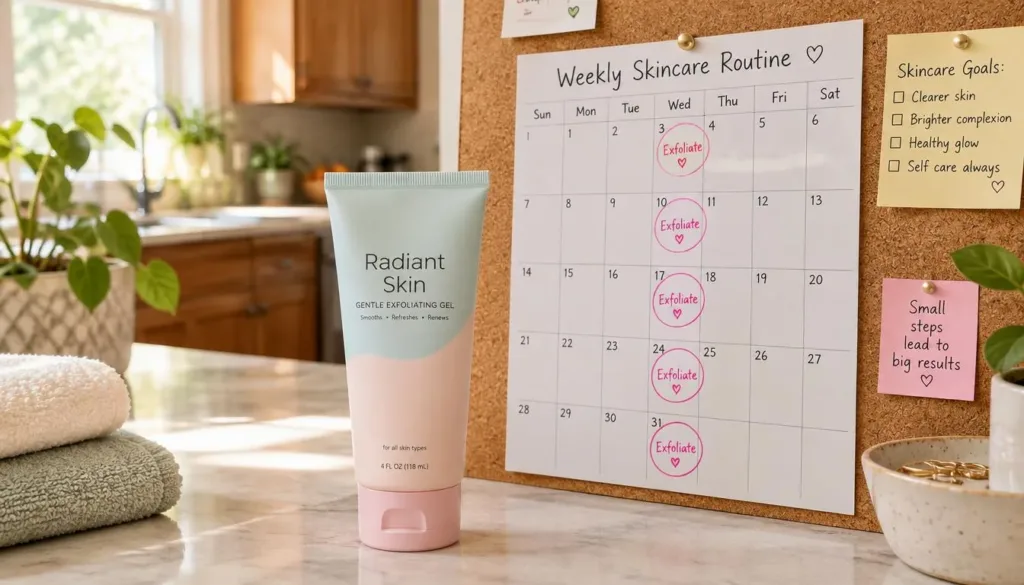
Common chemical exfoliant groups include AHAs and BHAs. Start with once or twice a week rather than daily use, then adjust to your skin’s tolerance. A gentle pace can make it easier to spot irritation before it builds.
Physical scrubs and tools can also add friction. Use them with care, especially if your skin already feels tender. Stop exfoliating while irritation or unusual sensitivity lasts.
Exfoliation does not promise to erase spots or fine lines. It can change how the surface feels, but results differ from one person to another. Daytime sunscreen is especially important when exfoliation is part of your routine.
Skip exfoliation whenever your skin is already irritated or unusually sensitive.
Retinoids, Bakuchiol, and the Claims Around Them
Retinal is the ingredient behind the “11 times faster” claim, but that figure comes from laboratory research rather than a head-to-head human trial. Lab results do not show how quickly a product changes skin in real life.
Retinol and retinal are cosmetic retinoids, a group of vitamin A derivatives used topically. Tretinoin is prescription topical retinoic acid. Retinal sits one conversion step closer to retinoic acid than retinol does.
Know the difference between retinol, retinal, and tretinoin
Those names refer to different ingredients, not simply different strengths of one product. Topical tretinoin has been tested in randomized controlled trials. These trials found improvement in fine wrinkling, mottled hyperpigmentation, roughness, and other signs of sun damage.
A lab comparison of how retinal converts does not show an 11-times-faster effect in people. That claim needs a direct study in people to show a real speed difference. A stronger-sounding number is not a promise of faster results.
Introduce a retinoid gradually
Start a retinoid gradually and follow its label or a clinician’s directions. Sensitive skin may need extra care when starting. Give your skin time to adjust before making changes to other active products.
Retinoids can be a treatment choice for concerns such as fine lines and wrinkles, but they do not suit every routine. Use the specific product directions rather than copying someone else’s schedule. Keep the rest of your routine simple when introducing one.
Keep bakuchiol claims in proportion
A 2019 randomized, double-blind study followed 44 participants for 12 weeks. One group used 0.5% bakuchiol cream twice daily, and the other used 0.5% retinol cream once daily. Both groups had reduced wrinkle surface area and hyperpigmentation.
The study found no statistically significant difference between the groups, and the retinol group reported more scaling and stinging. The groups used different schedules, so the study does not establish equivalence. Bakuchiol is not a retinoid, and this study does not establish how it compares with tretinoin.
Treat a dramatic ingredient comparison as a reason to check the study design, not as a promise of faster results.
Choose Moisturizer and Face Oil by Feel
Cream and moisturizer are not competing steps, because a cream can be your moisturizer. Texture describes how a product feels, while moisturizer describes its role.
A cream may moisturize on its own, so you do not automatically need two separate products. If you use moisturizer and a richer face oil, apply moisturizer first and oil afterward.
Choose a moisturizer that feels comfortable on your face. A lotion may feel lighter, while a cream may feel richer. Skin type can guide the first choice, but comfort is a useful test in daily use.
Dry skin may feel better with a richer cream, while some people prefer a lighter texture. These are options, not rules for every person. A product that feels heavy or leaves skin uncomfortable may not suit your routine.
Face oil is an optional richer layer. Use it after moisturizer if it feels heavier than the products beneath it. Skip it if it feels too heavy or tends to clog your pores.
Use a separate face oil only if it adds comfort your moisturizer does not.
Finish With Sunscreen, Then Apply Makeup
Apply sunscreen after your other skincare and before makeup. Broad-spectrum protection covers both UVA and UVB rays, so choose a formula you can use comfortably.
Sunscreen is the final skincare step, and makeup goes over it. Check the label for broad-spectrum wording, SPF, directions, and water-resistance instructions when relevant. A sunscreen product should fit your routine well enough that you will use it as directed.
In the United States, an over-the-counter sunscreen can be marketed without an approved drug application when it meets FDA sunscreen monograph requirements. Those rules cover permitted active ingredients, uses, and doses. This is a specific route for sunscreen products, not a sign that every cosmetic is FDA-approved.
Bemotrizinol is an example of a permitted sunscreen active ingredient. The FDA considers it generally recognized as safe and effective for sunscreen use by adults and children 6 months and older, at concentrations up to 6%. This regulatory example is not a recommendation to choose one product over another.
When choosing sunscreen, look for broad-spectrum protection and an SPF you can apply as directed. Makeup can go on top after the sunscreen layer. A makeup product with SPF does not change where sunscreen belongs in the sequence.
- Broad-spectrum wording on the label.
- SPF listed on the product.
- Directions for use.
- Water-resistance instructions when relevant.
Follow the sunscreen label’s directions for use and reapplication.
Where Do Face Masks and Korean-Style Layers Fit?
A mask’s format tells you where it fits: rinse-off masks come off before leave-on treatments, while sheet masks stay on. Read the directions because masks do not all work the same way.
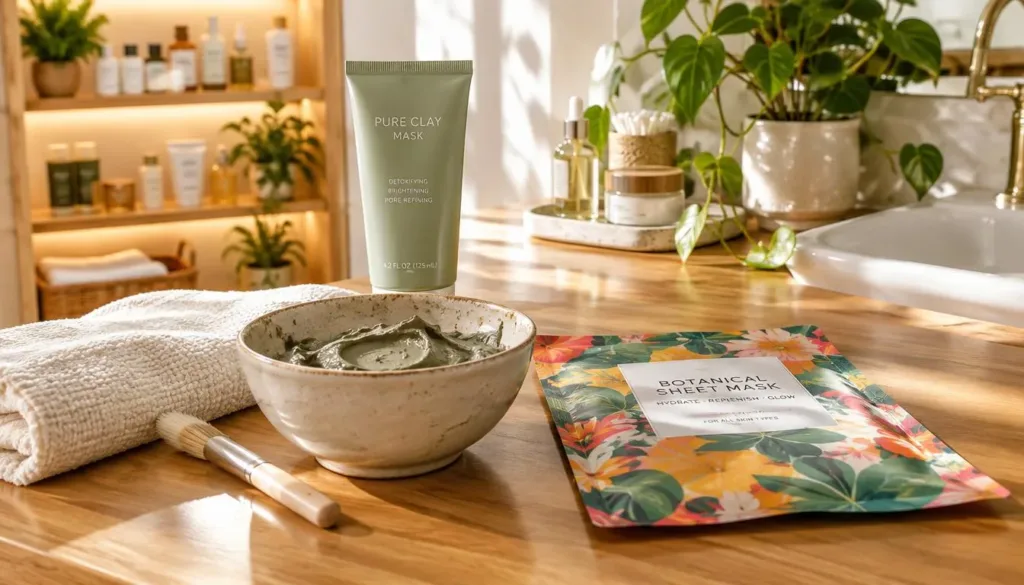
A rinse-off clay mask generally follows cleansing and should be rinsed away before serum or treatment. A sheet mask is a leave-on layer that usually goes before moisturizer, unless its directions say otherwise. Mask format, not a fixed step count, sets its place in the routine.
Place a mask by whether you rinse it off
After a clay mask, rinse your face as directed before applying leave-on products. A sheet mask stays on the skin, so it usually fits before moisturizer. Follow the package directions if it gives a different order or timing.
A mask is an optional product, not a required treatment. If your skin feels irritated, adding a mask may not help. Keep the routine comfortable rather than trying several new layers at once.
Borrow the layering logic, not a required step count
Korean skincare product order uses the same practical layering logic: cleanser first, treatment layers next, and moisturizer afterward. The products can vary, but no fixed number of steps is required. Choose only the layers that suit your skin needs.
For a daily skin care routine aimed at a glowing look, focus on comfortable cleansing, hydration, and daytime sunscreen. Stacking masks and active treatments can add complexity without making a routine more useful. A simple routine can still include an optional sheet mask when it feels good on your skin.
Use a mask only when its format and directions fit your routine, and skip it when skin is irritated.
Follow the mask’s directions and skip it if your skin is already irritated.
Conclusion
A steady, comfortable routine matters more than adding another step. Skin tolerance should guide treatment choices, especially when you are deciding whether to keep or remove an active product.
Write down the products you already use, put them in order, and remove a duplicate active if irritation is a concern. That small check can make the routine easier to understand without buying anything new.
Try the simpler order for a few weeks, changing one product at a time if you need to adjust.